Table of Contents
Healthcare providers today face a triple challenge: navigating substantial macroeconomic headwinds, preparing a wave of groundbreaking innovations, and improving patient outcomes.
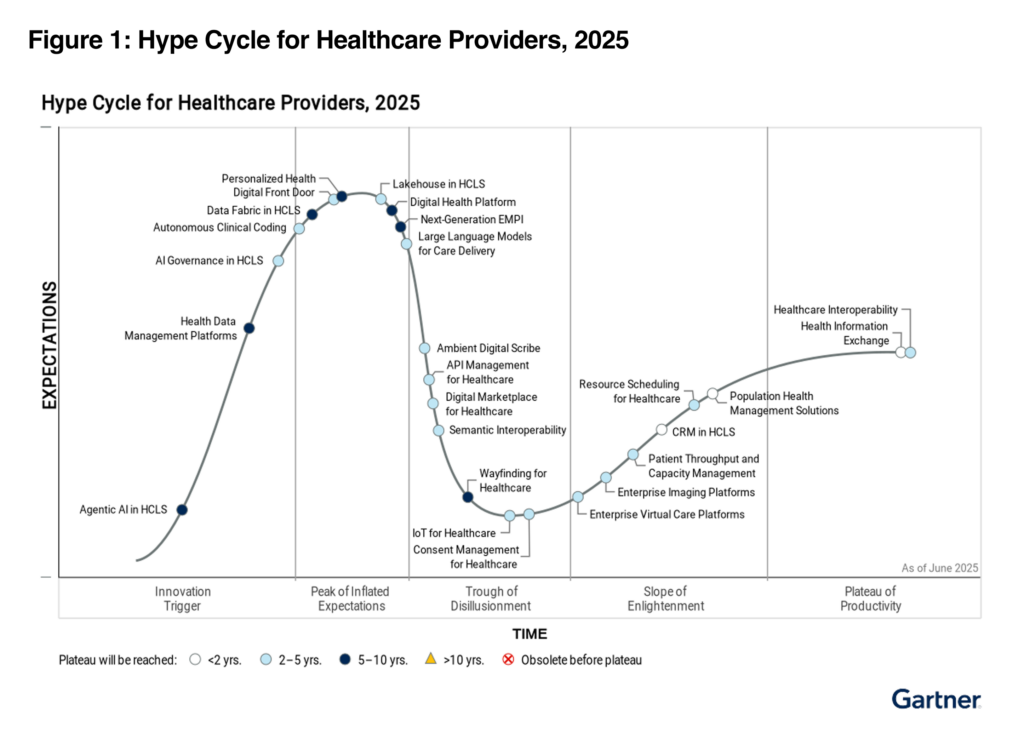
The Gartner® Hype CycleTM for Providers, 2025 monitors digital innovations and market solutions that are enhancing and transforming operations and care delivery.
For CIOs and Healthcare and Life Sciences (HCLS) leaders, we think this report helps evaluate the true value and impact of emerging technologies, distinguishing between fleeting trends and solutions that will shape the future. By understanding where technologies sit on the Gartner® Hype CycleTM, we believe healthcare leaders can develop more effective digital strategies and technology roadmaps for their businesses.
According to the report, four main themes are emerging this year that will define the next two to five years of healthcare technology.
1. Increasing Adoption and Integration of AI
Healthcare providers are actively operationalizing Artificial Intelligence to advance patient outcomes, develop personalized treatment plans, and accelerate drug discovery. In addition, organizations are leveraging ambient digital scribes to automate documentation, a critical move to combat clinician burnout. We are also seeing the broad application of large language models (LLMs) for tasks ranging from clinical summarization to patient communication. Furthermore, the development of agentic AI is beginning to automate complex workflows. This again helps combat clinician and workforce burnout.
Why it Matters: These technologies, supported by data from the Internet of Things (IoT) and data interoperability, are driving initiatives like personalized health. As a result, they aim to transform care from reactive treatment to proactive prevention.
2. Modernizing Data Management and Enhancing Interoperability
Data is still the beating heart of digital health, but the way we’re juggling it is undergoing a serious vibe shift. The data fabric concept offers a design for flexible data integration, which is necessary for composable healthcare enterprises and advanced AI use cases. Crucially, API management, particularly when adopting Fast Healthcare Interoperability Resources (FHIR) standards, is essential.
Why it Matters: Data modernization and increased interoperability allow for the creation, provisioning, and monitoring of APIs, enabling secure and efficient data exchange with both internal and external partners.
3. Shifting Toward Flexible Digital Architectures
Healthcare providers are moving away from monolithic systems toward digital health platforms (DHPs). By leveraging the power of the cloud, healthcare companies can harness massive amounts of data, prebuilt capabilities, and specialized tools to augment existing application portfolios such as electronic health records (EHRs) and accelerate innovation. This approach reduces reliance on rigid and potentially less secure legacy systems.
Why it Matters: Digital marketplaces are driving this transformation by making it easier to discover, evaluate, and acquire modular technologies and services. With cloud-based operations and flexible digital architectures, healthcare organizations can deliver faster, more effective innovations for their patients.
4. Addressing Workforce Challenges and Governance
The shortage of clinicians, staff, and cybersecurity skills is not a new challenge. As healthcare continues to evolve, technology must support the people who rely on it. Innovations like virtual care platforms and ambient digital scribes have emerged as critical solutions to clinician burnout and staffing shortages. These tools streamline workflows, reduce administrative burdens, and ultimately enhance the well-being of healthcare professionals while improving patient care. However, the increasing use of AI enabled tools requires comprehensive AI governance frameworks.
Why it Matters: Evolving digital marketplaces are supporting this shift by facilitating the discovery, evaluation, and procurement of modular technology and services. Flexible digital architectures and operating in the cloud enables healthcare organizations to innovate faster and better for their patients.
Conclusion
Gartner® Hype Cycle™ for Healthcare Providers, 2025 offers a roadmap for navigating healthcare innovation. By assessing the report, we believe healthcare CIOs can prioritize investments that deliver measurable clinical and operational value.
Ready to dive deeper into how these technologies and the full Hype Cycle™, you can still access it on Gartner's website.
Required Trademark Disclaimer and Attribution:
Gartner and Hype Cycle are trademarks of Gartner, Inc. and/or its affiliates.
Gartner does not endorse any company, vendor, product or service depicted in its publications, and does not advise technology users to select only those vendors with the highest ratings or other designation. Gartner publications consist of the opinions of Gartner’s business and technology insights organization and should not be construed as statements of fact. Gartner disclaims all warranties, expressed or implied, with respect to this publication, including any warranties of merchantability or fitness for a particular purpose.
Gartner, Hype Cycle for U.S. Healthcare Payers, 2025, By Robert Potts, Connie Salgy, 16 June 2025.
This graphic was published by Gartner, Inc. as part of a larger research document and should be evaluated in the context of the entire document. The Gartner document is available upon request from ClearDATA.