Table of Contents
AI Is Accelerating, and So Is the Risk
AI is being adopted in healthcare faster than almost any technology before it, with tools like ambient scribes, diagnostic support, and chatbots already in use. Healthcare organizations are turning to AI to combat workforce shortages, reduce administrative burdens, and empower teams to solve problems on the front lines.
However, this speed creates a conflict with healthcare’s unique challenges: a volatile regulatory landscape, strict patient safety duties, and high reputational stakes. An AI failure in healthcare can have life-or-death consequences.
This is the core tension for every healthcare technology leader: enabling innovation without sacrificing trust. A structured approach to AI governance is the solution. This post will guide you through the AI TRiSM framework, explaining why healthcare demands robust governance and helping you decide whether to build or buy.
What is AI TRiSM (AI Trust, Risk, and Security Management)?
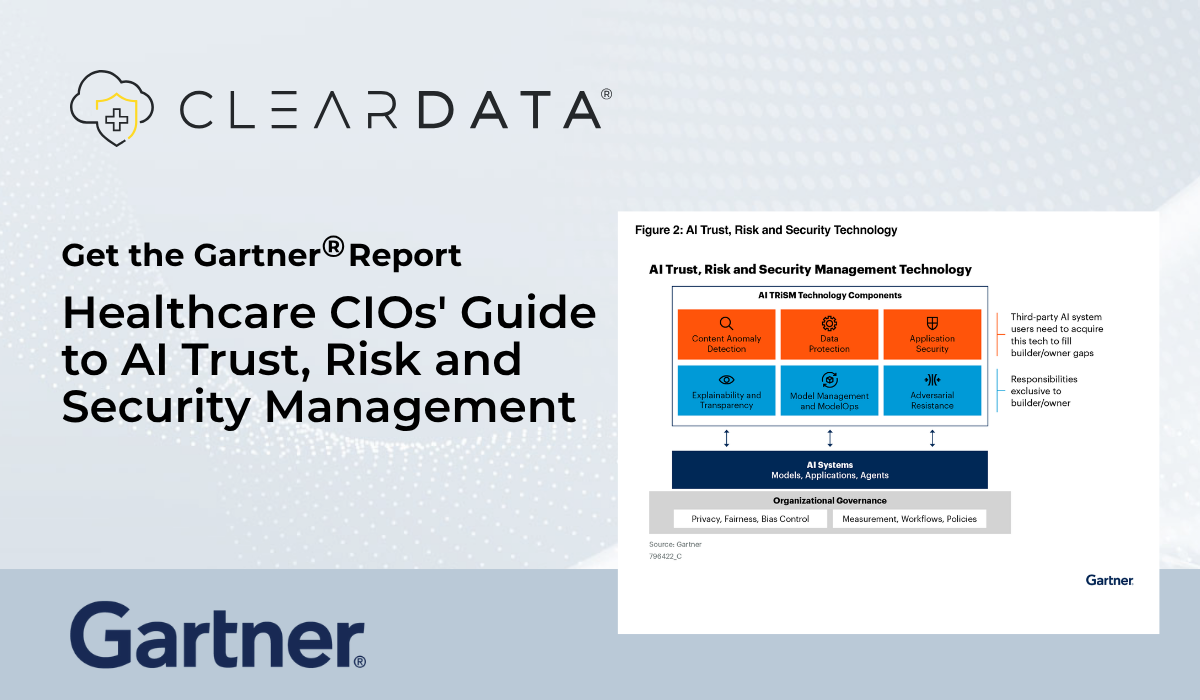
AI TRiSM, short for AI trust, risk, and security management, is a framework designed to ensure the governance, trustworthiness, fairness, reliability, robustness, efficacy, and data protection of AI models and applications throughout their entire life cycle. It combines AI-specific technology functions with traditional technology functions to achieve these goals. In practice, AI TRiSM addresses four connected areas:
- Governance: Establishes the policies and procedures that manage AI assets, keeping them aligned with regulations and ethical standards.
- Risk management: Identifies and mitigates the risks tied to AI, including patient data privacy, security vulnerabilities, and bias in AI output.
- Security: Protects AI models and applications from adversarial attacks and ensures the integrity of data used in AI processes
- Monitoring and evaluation: Continuously assesses AI performance, reliability, and compliance with established policies, allowing for timely adjustments and improvements Think of these four areas as a continuous operating state rather than a one-time project. AI changes after deployment, and so do the regulations around it. Governance that works has to be ongoing.
Why Healthcare Needs AI Governance More Than Other Industries
Healthcare carries a unique combination of pressures that make responsible AI a higher-stakes discipline than in nearly any other sector. Regulatory volatility, patient safety obligations, severe workforce shortages, and the reputational fallout of a public AI failure all converge here. Trust in the privacy, security, and accuracy of AI outputs is foundational—without it, scaling AI safely simply isn’t possible.
Let’s break down what’s driving that intensity.
Regulatory volatility: U.S. federal policy shifts create global ripple effects, while local and state regulations add their own compliance complexity. The rules governing how you deploy AI can change faster than your deployment timeline. A governance layer gives you a way to absorb that change without re-architecting everything each time.
Workforce shortages: AI adoption isn’t optional when your teams are stretched thin. Automation helps relieve administrative burden and clinician fatigue. But rushing tools into production without oversight trades one risk for another.
Patient safety and auditability. AI in healthcare can influence diagnosis, course of care, and member interactions. Outcomes must be consistent, defensible, and auditable. When a regulator, board member, or patient asks how a decision was made, you need an answer—and a record.
Reputational stakes: AI failures in healthcare make headlines. Public and organizational trust, once lost, is slow and expensive to rebuild. Strong governance protects more than data; it protects the credibility your organization depends on to operate.
Growing threat landscape: Adversaries are already weaponizing AI—refining phishing lures, automating reconnaissance, and exploiting integrated AI assistants through prompt injection. Shadow AI, where well-meaning staff paste protected health information (PHI) into public tools, creates data-leakage risks that bypass traditional controls entirely. Governance is how you stay ahead of both the regulatory and the security curve.
The AI Technology Sandwich and the “TRiSM-Rich” Archetype
Gartner® describes AI deployment using a “technology sandwich”—a layered model that includes bring-your-own (BYO) AI, embedded AI, centralized data, a TRiSM layer, and external data. How thick each layer is depends on your industry and risk profile. For healthcare, the TRiSM layer carries far more weight than it does elsewhere.
The Three AI Sandwich Archetypes
Gartner® identifies three archetypes of the AI tech sandwich. The first, the vendor-packaged archetype relies on purchased, pre-built AI with a lighter governance layer. The TRiSM-rich archetype features a much thicker, more robust governance “patty,” where every AI initiative is routed through strong trust, risk, and security controls. The last, the deluxe archetype combines extensive build capabilities with a heavy TRiSM layer—suited to organizations with deep AI expertise.
What a TRiSM-Rich Approach Requires
Operating a TRiSM-rich model has practical implications for how you structure AI across the organization. To deliver it effectively, you must:
- Rely more on centralized data, rather than scattered, ungoverned data sources.
- Limit bring-your-own AI (BYOAI) to reduce shadow AI risk and maintain visibility.
- Selectively employ built and embedded AI, choosing each deployment deliberately.
- Route all AI through the TRiSM layer, regardless of source. No exceptions.
That last point matters most. Whether a model is built in-house, embedded in a vendor product, or accessed through an API, it has to pass through the same governance, security, and monitoring controls. Consistency is what makes the layer defensible.
Core Components of an AI TRiSM Layer
A complete AI TRiSM layer combines several technical functions that work together across the AI life cycle. Each addresses a distinct risk, and together they give you the visibility and control to scale AI without losing your compliance footing.
Model Monitoring, Management, and Operations: Models drift. The performance you validate at launch isn’t guaranteed six months later as data and conditions change. Continuous model monitoring tracks accuracy, reliability, and behavior over time, while model management and operations (sometimes called ModelOps) governs versioning, deployment, and retirement. This is how you catch degradation before it reaches a patient or a member.
Interpretability and Explainability: In healthcare, “the model said so” is never an acceptable answer. Interpretability and explainability give you the ability to understand and articulate how an AI system reaches its conclusions. That’s essential for clinician trust, for regulatory compliance, and for the auditability your board and external reviewers will expect.
Data and Content Anomaly Detection: AI is only as trustworthy as the data feeding it. Anomaly detection identifies unusual or corrupted inputs and outputs—whether from data quality issues, poisoning attempts, or unexpected model behavior. In a sector where a bad input can distort a clinical recommendation, this early-warning function is critical.
AI Data Protection: AI systems process some of the most sensitive data your organization holds. AI data protection safeguards PHI and other regulated information throughout the AI life cycle, aligning with HIPAA, HITRUST, and your broader compliance obligations. This includes protecting data in training, in inference, and in storage—closing the gaps that shadow AI and misconfiguration tend to open.
Adversarial Attack Resistance and AI-Specific Application Security: AI models require more than traditional application security. Adversarial attack resistance defends your models from manipulation like data poisoning and prompt injection, while AI-specific application security hardens the surrounding systems. As AI threats grow, this layer is crucial to protect your model’s integrity and the trust of your stakeholders.
Build vs. Buy — Choosing AI Solutions Responsibly
Even in a TRiSM-rich environment, you’ll face a recurring decision: build your own AI solution, buy from a vendor, or pursue a hybrid of both. There’s no universal answer. The right choice depends on the use case, your internal expertise, and the value you’re trying to create. Knowing when to do which is what protects both your budget and your risk posture.
When to Build
Building can be the better path when specific conditions are met. As a general guide, consider building when:
- The use case is unique and differentiating, giving you control of intellectual property and a chance to monetize it.
- Vendor availability is scarce or unproven, leaving no reliable off-the-shelf option.
- You need maximum control over data, or existing solutions are noncompliant—or at risk of noncompliance—with HIPAA and other regulations.
- Existing solutions can’t integrate cleanly with your IT systems, electronic health records (EHRs), or operational workflows.
Keep the trade-offs in view. Building internally requires strong AI expertise, substantial upfront investment in infrastructure and talent, and ongoing maintenance. It also takes longer to deliver value. For many organizations, a hybrid approach—extending or customizing purchased models—offers the best balance.
Five Categories for Evaluating Generative AI Vendors
Thorough vendor vetting becomes your most important safeguard. Evaluate every potential partner across these five categories, with healthcare-specific scrutiny applied throughout:
Business impact: Probing into the business value prompts vendors to articulate the specific benefits and outcomes their generative AI products can deliver, ensuring clarity and transparency in the procurement process.
- Healthcare organizations should prioritize nonfinancial sources of value in addition to the traditional sources of increased revenue, mitigation of risk and increased efficiency.
- Nonfinancial value can include sources such as improved clinical outcomes and increased satisfaction of employees or members/patients, among others, which are critical wells of value in the industry.
Enterprise guardrails: Understanding the mechanisms and protocols in place to safeguard sensitive data, mitigate risks and uphold ethical standards is crucial for compliance and risk management especially in a highly-regulated industry like healthcare.
- These guardrails encompass factors such as data privacy, bias mitigation/ethical considerations, model interpretability/explainability and regulatory compliance, among others.
- By asking vendors about these guardrails, enterprises can assess the product’s reliability, transparency and adherence to industry best practices.
Technology: Evaluating the capabilities, performance and quality, customization and integration abilities of the vendor solution is key, of course.
- In healthcare, where technology can not only be member- or patient-facing, but can impact the course of care or diagnosis, extra scrutiny must be placed on proving these capabilities and an ongoing level of quality.
- In addition, healthcare adoption of new technology can be extremely low where integration is not as seamless as possible, and when the technology operates outside of the normal workflow or extra steps are needed. The ability to work within existing tools and workflows should be proven by the vendors.
Pricing and costs: Cost is one of the greatest near-term threats to generative AI success. The pricing of AI solutions can be complex and difficult to accurately measure, especially moving from pilot to at scale.
- More than half of organizations abandon their efforts due to cost related missteps.1 Healthcare organizations, at this stage, typically have a very limited budget allocation for AI initiatives.
- Even though investments are growing, accurate cost analysis and forecasting is absolutely necessary for success and is likely a differentiator among vendors to determine the right fit for the organization’s needs.
- Another aspect of this category is licensing and contracting. Evaluating vendor contracts for AI procurement is similar to that of other technology, but there are additional considerations of risk, ownership and cost management, so a specialized eye should be employed to review and approve.
Roadmap and support: This category includes support and maintenance, scalability and resource requirements, and future development, and can often be overlooked as less important as the other categories. However, the foundation of the vendor relationship is contained within this category.
- A large portion of complaints from healthcare clients regarding their technology vendors come not from capabilities or integration concerns, but from overpromising and underdelivering, not being transparent about beta testing, inability to scale, and lack of ongoing support for teams within the organization needing to configure or maintain solutions.
Your Next Steps Toward Resilient AI Governance
Strong AI governance in healthcare comes from deliberate, sequential action—not from a single purchase. Use this checklist to put a resilient, safe, and effective AI strategy in motion:
- Evaluate your existing TRiSM foundation and technology. Take inventory of the governance, risk, security, and monitoring capabilities you already have. Map where AI is running today (including shadow AI) and identify which controls are missing or inconsistent.
- Build out the TRiSM layer and fill any gaps, using a TRiSM-rich approach. Using a TRiSM-rich approach, strengthen each component until every AI initiative routes through consistent governance, security, and monitoring. Centralize data, limit BYOAI, and make the TRiSM layer non-negotiable for all AI, regardless of source.
- Determine your deployment strategies for AI needs and thoroughly vet vendors against value, security and feasibility. Decide where to build, buy, or blend. Then evaluate vendors rigorously against value, security, and feasibility using the five categories above, confirming compliance and references before you scale.
Treat this as an ongoing operating rhythm, not a finish line. The organizations that govern AI well are the ones that revisit these steps continuously as models, threats, and regulations evolve.
Healthcare AI Governance as your Foundation
The key is to reframe AI governance not as a barrier to innovation, but as its foundation. A strong AI TRiSM framework enables teams to innovate quickly and safely, with trust, risk, and security controls operating in the background.
At ClearDATA, we specialize exclusively in healthcare cloud security and operations, offering a continuous governance model that manages issues from discovery to resolution.
To learn more, download the Gartner® report, Healthcare CIOs’ Guide to AI Trust, Risk and Security Management.
Gartner, Healthcare CIOs’ Guide to AI Trust, Risk and Security Management, Amanda Dall’Occhio, 2 May 2025
GARTNER is a trademark of Gartner, Inc. and/or its affiliates.